


Updated: 2026
Artificial intelligence is now an integral part of everyday business operations. Companies use it to automate processes, analyze data, and enhance customer interactions. What began as a research topic has become a practical tool across industries.
Many organizations already rely on AI in at least one business function. The focus has shifted from experimentation to real business value. This article explains the most important benefits of AI and where they create measurable impact.
Table of Contents
Artificial intelligence refers to systems that can process data, identify patterns, and support tasks that typically require human input. These systems are based on machine learning, statistical models, and increasingly generative AI.
Today, AI is used across a wide range of applications, including automating workflows, analyzing large datasets, generating content, and supporting software development. AI-powered coding tools can generate code, assist with debugging, and improve development efficiency.
The value of AI depends on how well it is trained, the quality of the data, and how effectively it is integrated into business processes.
Tip:
Do you need high-quality data to train or improve AI models? LXT+clickworker combine managed services with a global crowd of millions to collect and annotate text, image, audio, and video data across languages and markets. This helps companies scale AI projects faster and with consistent quality.
Explore AI Training Data
Artificial intelligence provides measurable advantages across business functions. The following benefits show where AI creates real impact when applied with the right data and clear use cases.
While not every benefit applies equally to every organization, most companies use AI to improve efficiency, scale operations, and make better decisions.
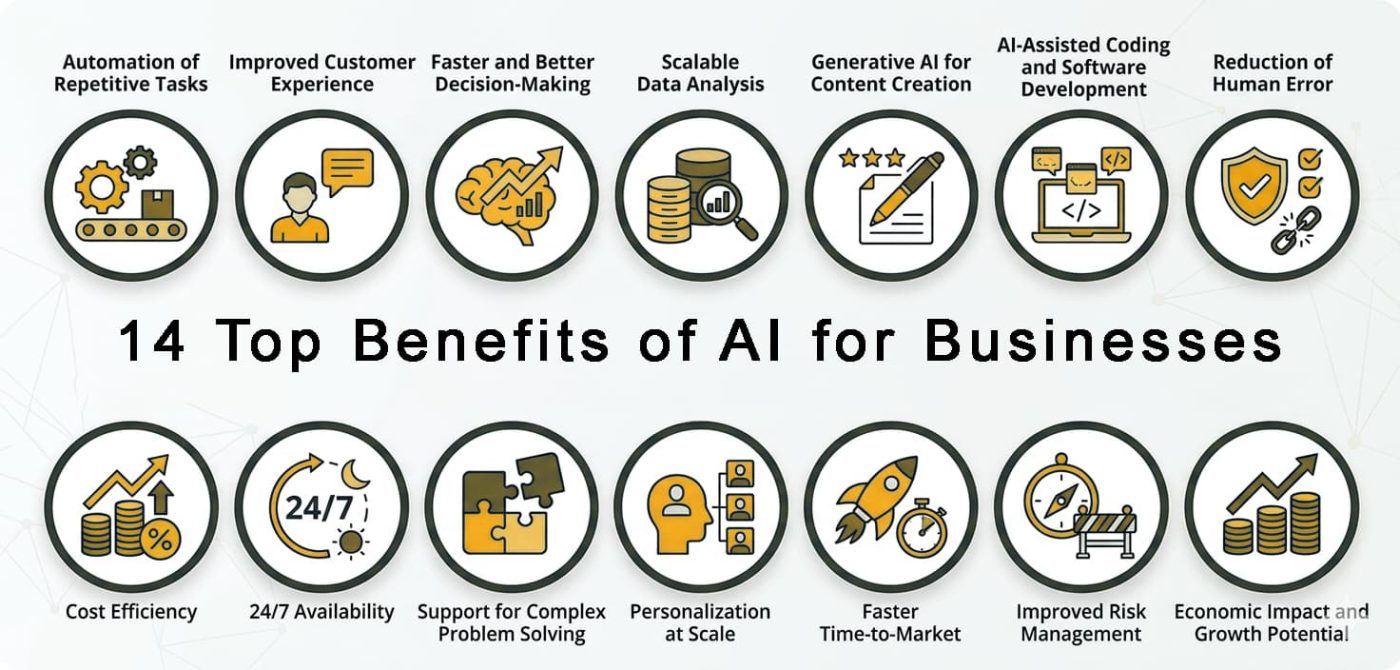
AI automates rule-based and repetitive tasks such as data entry, tagging, and basic customer interactions. This reduces manual effort and increases productivity.
AI-powered systems provide faster responses and personalized interactions. This improves customer satisfaction and reduces pressure on support teams.
AI analyzes large datasets and identifies patterns that support data-driven decisions in areas like pricing, forecasting, and operations.
AI processes large volumes of structured and unstructured data quickly. This supports research, product development, and market insights.
Generative AI creates text, images, summaries, and more. It supports marketing, documentation, and internal workflows.
AI tools support developers by generating code, suggesting improvements, and automating testing. This speeds up development cycles and reduces manual effort.
AI systems follow consistent rules and validation steps, reducing errors in repetitive and data-heavy processes.
Automation and improved resource allocation help reduce operational costs while maintaining consistent output quality.
AI systems operate continuously, supporting global operations and customer interactions across time zones.
AI helps analyze multiple variables simultaneously, supporting use cases such as fraud detection and supply chain optimization.
AI enables tailored experiences for users, from product recommendations to personalized content and communication.
By automating processes and accelerating development, AI helps companies bring products and services to market faster.
AI models detect anomalies and predict risks, helping businesses respond earlier to potential issues.
AI contributes to economic growth by increasing productivity and enabling new business models, while also reshaping job roles.
Artificial intelligence delivers measurable value across industries. The impact depends on how well AI is integrated into workflows and whether the underlying data supports the use case.
The following examples show how businesses apply AI in practice and where it creates real advantages.
AI improves customer service by handling high volumes of inquiries in real time. Chatbots and virtual assistants resolve routine requests, while AI systems route complex issues to human agents.
This reduces response times, lowers support costs, and allows teams to focus on higher-value interactions.
Retailers use AI to personalize shopping experiences, recommend products, and forecast demand. AI also helps optimize pricing and inventory management based on real-time data.
The result is higher conversion rates, improved customer retention, and more efficient supply chains.
AI supports campaign optimization, audience targeting, and content generation. It analyzes user behavior and performance data to improve marketing outcomes.
This helps teams run more effective campaigns and allocate budgets more efficiently.
AI supports fraud detection, credit scoring, and risk assessment by analyzing large volumes of transactional data. It identifies anomalies and patterns that would be difficult to detect manually.
This improves accuracy, reduces financial risk, and speeds up decision-making processes.
Healthcare organizations use AI to analyze medical data, support diagnostics, and manage patient records. AI models assist in identifying patterns in imaging data and clinical results.
AI can improve efficiency and support earlier detection of diseases, but results depend on high-quality and well-annotated data.
In manufacturing, AI enables predictive maintenance, quality control, and process optimization. Machines can detect anomalies and predict failures before they occur.
This reduces downtime, lowers maintenance costs, and improves production output.
AI optimizes route planning, fleet management, and delivery schedules by processing real-time data such as traffic conditions and demand patterns.
This leads to faster deliveries, lower fuel consumption, and more efficient logistics operations.
AI tools support developers by generating code, suggesting improvements, and automating testing and debugging tasks. This helps reduce development time and improves code quality.
Human review remains essential to ensure reliability, maintain security standards, and validate outputs.
AI systems monitor networks and detect unusual patterns that may indicate security threats. They can respond faster than traditional rule-based systems.
This helps organizations identify potential attacks early and reduce the risk of data breaches.
AI is used in recruiting, candidate screening, and workforce analytics. It helps identify suitable candidates and streamline hiring processes.
This reduces time-to-hire and supports more consistent decision-making in talent management.
AI is used for content recommendation, media analysis, and automated content creation. Platforms analyze user behavior to deliver personalized experiences.
This increases engagement and supports scalable content production.
AI helps predict energy demand, optimize grid operations, and detect anomalies in infrastructure systems.
This improves efficiency, reduces waste, and supports more stable energy supply.
Reading Tip:
If you want to explore how AI can benefit the environment and support sustainability efforts, read our article “Benefits of artificial intelligence (AI) for the environment“.
The benefits of AI are well documented, but successful implementation depends on more than just technology. Many AI initiatives fail to deliver value because key prerequisites are missing.
To achieve reliable results, businesses need to focus on the following factors:
AI systems depend on large volumes of accurate and relevant data. Poor-quality or biased data leads to unreliable outputs and limits the effectiveness of models.
Data must be collected, cleaned, and annotated carefully to reflect real-world conditions and use cases.
AI should be applied to well-defined problems with measurable outcomes. Vague or overly broad initiatives often fail to deliver tangible results.
Successful projects focus on specific processes such as automation, forecasting, or customer interaction.
AI solutions must fit into existing workflows, tools, and infrastructure. Standalone systems rarely create long-term value.
Integration ensures that insights and outputs can be used directly in day-to-day operations.
AI outputs require human review, especially in high-risk or complex applications. Human oversight helps detect errors, validate results, and maintain accountability.
This is particularly important in areas such as healthcare, finance, and customer communication.
As AI projects grow, businesses need scalable processes for data collection, annotation, and validation. This includes access to diverse data sources across languages and regions.
Without scalable data operations, it becomes difficult to expand AI use cases beyond initial pilots.
AI systems must comply with regulations and internal policies. This includes data protection, transparency, and risk management requirements.
Frameworks such as the EU AI Act introduce obligations that businesses must consider when deploying AI solutions.
AI requires the right infrastructure, including computing resources, storage, and deployment pipelines. Cloud-based environments often support flexibility and scalability.
Without the necessary infrastructure, performance and reliability can be affected.
Successful AI projects involve collaboration between data scientists, engineers, and business teams. Each group contributes different expertise.
Clear communication between technical and non-technical stakeholders is essential to align AI outputs with business needs.
AI models need regular updates and monitoring to maintain performance. Data changes over time, and models must adapt to new conditions.
Ongoing evaluation helps detect performance issues and ensures long-term reliability.
Artificial intelligence offers many advantages, but it also comes with limitations that businesses need to understand before implementation. Not every process benefits from automation, and results are not always reliable without the right conditions.
Recognizing these limitations early helps organizations set realistic expectations and reduce risks when deploying AI systems.
Artificial intelligence has the potential to improve productivity, access to information, and quality of life. At the same time, it raises important questions about fairness, employment, and regulation.
On the positive side, AI can support areas such as education, healthcare, and accessibility by making services more widely available. It can also help individuals and organizations solve complex problems more efficiently.
However, there are also challenges. AI may change job roles, introduce bias through data, and require strong governance to ensure responsible use. Regulations such as the EU AI Act aim to address these risks by defining clear requirements for transparency and accountability.
The overall impact of AI on society depends on how it is developed, deployed, and governed. Businesses and policymakers play a central role in ensuring that AI systems are used responsibly and deliver long-term value.
Artificial intelligence is no longer limited to experimentation. It is a practical tool that supports automation, decision-making, and scalable data analysis across industries.
However, the benefits of AI do not come from the technology alone. Successful implementation depends on clear use cases, high-quality data, and the ability to integrate AI into existing business processes.
Organizations that invest in the right data, infrastructure, and workflows can scale AI beyond initial pilots and achieve measurable results. Those that overlook these foundations often struggle to realize long-term value.
As AI adoption continues to grow, the focus is shifting from potential to execution. Businesses that approach AI with a clear strategy and strong data foundation are better positioned to turn AI capabilities into real outcomes.
The main benefits include automation, improved decision-making, better customer experience, and scalable data analysis.
AI enables faster responses, personalized recommendations, and consistent service across channels.
Industries such as retail, finance, healthcare, manufacturing, and customer service benefit strongly from AI applications.
Risks include biased data, regulatory challenges, implementation complexity, and over-reliance on automated systems.
AI systems depend on high-quality data to learn patterns and deliver accurate results. Poor data leads to poor performance.


