


Defining a research question is the key to conducting a successful market research study. It serves as the starting point from which the entire study is directed. The precise formulation of a research question is crucial because it sets the framework for the entire research process and paves the way for systematic analysis. Market research isn’t just about collecting data, it’s about asking relevant questions that provide insight into the market, consumer behavior, or other relevant issues. A well-formulated research question is the key to gaining valuable insights and making effective business decisions.
For aspiring market researchers, newcomers and students, the requirements for formulating a research question can be challenging. The transition from academic theory to practical application in the world of market research requires not only theoretical knowledge, but also the ability to ask the right questions. The complexity of research processes and the need to meet both academic standards and the real needs of industry can lead to uncertainty. This blog post aims to help young researchers and students overcome these challenges by providing clear steps and practical tips for successfully formulating research questions.
Table of Contents
- Why is the Research Question Crucial?
- Distinguishing the Formulation of the Research Question from Hypotheses
- Types of Research Questions
- Criteria to define the Research Question
- Steps to define the Research Question
- Pitfalls in defining Research Questions
- Research Question in the Context of the Bachelor Thesis
- The Key Role of the Research Question in the Introduction of a Scientific Work
- Final Tips and Hints
- Conclusion on how to define the Research Question
- Literature Tips on the Topic of how to define the Research Question
- FAQs on how to define the Research Question
The research question is central to the entire research process. It serves as a guide and sets the course for the entire investigation. By formulating it precisely, researchers are able to maintain focus by setting clear boundaries for the scope of the study. The research question not only triggers data collection, but also influences the choice of research methods and the evaluation of results. It acts as a pacemaker, ensuring that each phase of the research process contributes to the ultimate goal of finding meaningful answers to the question posed.
The quality of a research study rises and falls with the quality of the research question. A clear, concise question minimizes the possibility of misunderstanding and ensures that the data collected is relevant and targeted. In addition, a well-crafted research question helps the study contribute to the existing body of knowledge. It can identify relationships, trends, or even reveal new perspectives that may be relevant to the industry.
The research question is closely linked to the overarching goals of the study. It should not be viewed in isolation but rather in clear alignment with the desired outcomes. When the research question is precisely aligned with the study’s objectives, not only does it enhance the relevance of the results, but it also boosts the efficiency of the entire research process. Therefore, it is crucial to consider the research question as an integral component of the overall strategy to ensure a successful and meaningful market research study..
While defining the research question establishes the starting point for a scientific investigation, hypotheses play a more specific role in the research process. It’s important to distinguish between these two concepts to understand their respective functions and purposes.
The research question is an open and inquiry-driven query that sets the focus of the study. It often aligns with a problem or gap in existing research and aims to define the scope and objectives of the investigation. The formulation of the research question is less specific than a hypothesis, allowing for a broader approach in data collection and analysis.
Hypotheses, on the other hand, are more precise and testable assumptions developed based on the research question. Hypotheses are speculative and make predictions about how certain variables may relate to each other. They are usually formulated in an “If…then…” structure and can be confirmed or refuted through empirical data verification.
The distinction between the research question and hypotheses lies in their specificity and testability. While the research question guides the overall path of the investigation, hypotheses provide specific assumptions about what is expected in the study. In many cases, multiple hypotheses can be derived from a comprehensive research question to specify different aspects of the inquiry.
It is crucial to articulate both research questions and hypotheses clearly and concisely to conduct a systematic and effective research study. While the research question determines the overall context of the investigation, hypotheses offer the opportunity to test specific predictions and contribute to deeper insights.
Choosing the correct type of research question is essential for aligning your study with your business goals and selecting the right global research participants. The following categories represent the most common approaches used in modern analytics.
Each type serves a unique purpose in the research cycle, from identifying new trends to confirming causal links between variables.
Tip:
A precise research question is only the first step. To validate it, you need reliable feedback from the right participants.
With the clickworker Survey Tool, you can create online surveys, reach suitable target groups, and collect structured data for your research project.
Choosing the correct type of research question is essential for aligning your study with your business goals and selecting the right global research participants. The following categories represent the most common approaches used in modern analytics.
Each type serves a unique purpose in the research cycle, from identifying new trends to confirming causal links between variables.
| Type | Core Focus | Example |
|---|---|---|
| Descriptive | Identifying facts and characteristics. | “What demographic characteristics influence buying behavior?” |
| Exploratory | Exploring “Why” or “How” in new areas. | “How do social media influence consumer behavior?” |
| Causal | Cause and effect relationships. | “What impact does a price change have on customer satisfaction?” |
| Comparative | Examining differences between groups. | “How do product preferences vary between age groups?” |
| Explanatory | Delving deeper into explaining relationships. | “Why do certain target groups prefer specific product features?” |
| Development-oriented | Focusing on the development of trends. | “How is consumer behavior evolving in emerging markets?” |
Defining an outstanding research question requires not only creativity but also a clear structure. Here are some criteria that can help you shape the perfect research question:
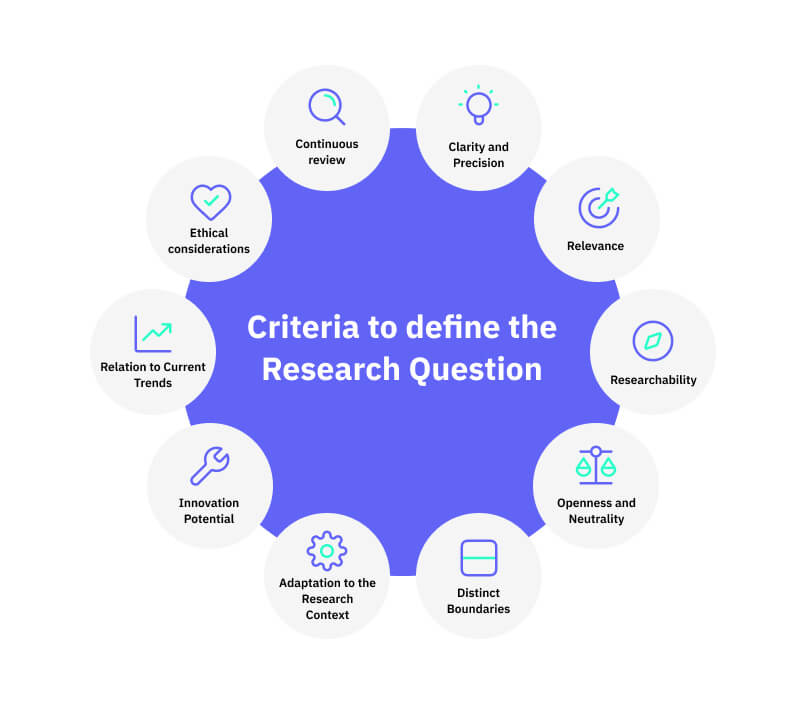
Clarity and Precision: Your question should be formulated clearly and precisely to avoid misunderstandings. Use clear terms and define technical terms to get unambiguous answers.
Relevance: The question should be directly related to your research goal. Ensure that each component of your research question contributes clearly to the overall study.
Researchability: Check whether the question can be researched with the available resources and methods. A realistic and feasible question is crucial for the success of your study.
Openness and Neutrality: Formulate your question openly and neutrally to encourage unbiased responses. Avoid suggestive vocabulary that may influence respondents’ opinions.
Distinct Boundaries: Set clear limits on the scope of your research. A question that is too broad can lead to confusing results, while a question that is too narrow will limit the scope of your study.
Adaptation to the Research Context: Consider the specific context of your research, whether it is in industry, academia, or another field. Your question should meet both academic standards and real-world needs.
Innovation Potential: Consider whether your research question can help fill existing knowledge gaps, provide new perspectives, or introduce innovative approaches.
Relation to Current Trends: Where relevant, ensure that your question relates to current trends or developments. This will contribute to the timeliness and relevance of your study.
Ethical considerations: Make sure that your question meets ethical standards. Protect the privacy of respondents and adhere to ethical guidelines that apply in your field of research.
Continuous review: Perfecting your research question is an ongoing process. Regularly check whether adjustments need to be made in the course of your research in order to meet changing requirements.
By following these criteria, you will create a solid basis for developing your research question.
Comprehensive background research lays the foundation for an informed research question. By using databases and peer-reviewed literature, researchers gain an in-depth understanding of existing studies and identify research gaps. These gaps are often the starting point for innovative and relevant research questions.
Clearly defining the research area is crucial to formulating a precise research question. This involves clearly defining the object of study and focusing on the relevant aspects.
The next step in formulating the research question is to define clear research objectives. The application of the SMART criteria plays a decisive role here – specific, measurable, achievable, relevant and time-bound.
The development of hypotheses can be useful to support the research question and stimulate further questions.
The choice of words is crucial. Use clear and concise language to ensure that your intentions are clearly understood.
The art of the research question holds pitfalls, especially for newcomers. Avoid typical pitfalls:
Unclear wording: Avoid vague wording. Precision is the key to avoiding misunderstandings.
Questions that are too broad or too narrow: Find the right measure. Questions that are too broad lead to confusing results, while questions that are too narrow limit the scope of the study.
Lack of connection to research objectives: Make sure your question fits seamlessly with the overall objectives of your study. Coherence is key.
Lack of reference to the discipline: A direct connection to the discipline is essential in undergraduate theses. Skillfully integrate your research question into the broader context.
Don’t pay attention to formalities: Don’t forget the formal requirements of your university. A clear and well-structured question will strengthen your work. Pay particular attention to the next section.
Be prepared for these pitfalls in order to develop a precise and effective research question.
Defining the research question for a bachelor thesis requires specific considerations and adaptations to the structure and objectives of the thesis.
A seamless connection between the research question, the introduction and the research objectives is crucial for the success of a bachelor thesis.
Consider the specific requirements of your university and the examination board when formulating your research question.
Formulating a research question for a bachelor’s thesis therefore requires not only a clear and precise focus, but also consideration of the formal requirements of the university. A clear and well-structured research question will strengthen your bachelor thesis and promote the success of your academic performance.
The introduction of a scientific work plays a crucial role in capturing the readers’ interest and establishing the context for the upcoming research. The formulation of the research question in this section is of essential importance as it lays the foundation for the entire study.
Introduction to the Research Topic:
Sharpening Focus through the Research Question:
Emphasizing Relevance:
Indication of Research Gaps:
Introduction to the Methodology:
The skillful integration of the research question into the introduction not only establishes a clear path for the readers but also elucidates the motivation for the research. Readers gain a clear overview of the problem addressed by the study and understand why it is crucial to explore this issue. This targeted focus on the research question contributes to sparking interest and laying the groundwork for a systematic investigation.
Harness the power of collective thinking by peer reviewing your research question. Colleagues and experts can provide valuable feedback and shed light on aspects you may have overlooked in your own formulation.
Be prepared to adjust your research question as new insights emerge during the research process. Flexibility to make changes allows for a dynamic and effective research study.
Open and regular communication with supervisors and colleagues is essential. Feedback in the early stages of research can provide valuable insights and improve the quality of your research question.
Continuous improvement of your research question through peer review, adjustments during the research process and transparent communication will support the success of your research study and contribute to its quality.
In summary, carefully defining your research question is the economic and scientific insurance for any market research project. It is much more than a mere introductory sentence, it forms the strategic framework that determines the quality of the insights gained. A sharp focus conserves valuable resources and ensures that the results actually contribute to solving the original problem.
The symbiosis of a precise question and a high-performance panel provider allows researchers to test hypotheses on a solid empirical basis. With partners like clickworker, the journey from the initial question to final data analysis is designed to be efficient and targeted.
Do you want to put your research question into practice? Use clickworker for targeted survey recruitment and secure access to valid, global data.
“The essential guide to doing your research project” by Zina O’Leary
This practical guide, now in its fourth edition, offers valuable insights for every stage of your research project; from choosing design and methodology to collecting, analyzing, and presenting data. Packed with real-world advice, it includes specific guidance on digital and online research, empowering you to confidently share your findings. Decision trees in each chapter help map your research journey, fostering reflection and critical thinking.
“How to research qualitatively” by Martin Gertler
This guide deepens your understanding of qualitative research methods, emphasizing effective use of analysis tools. Whether you’re a student, researcher, or professional, it equips you with essential skills for conducting qualitative research, analyzing data, and gaining meaningful insights. With 12 chapters, explore techniques, ethics, and software tools to streamline your research. The course guides you on preparing for your thesis or dissertation defense. Designed for independent study, it provides concise terms for contextual understanding, allowing you to dive into specific chapters without extensive background reading. An inspirational resource for qualitative social science research.
“Research methods for business students” by Mark Saunders, Philip Lewis, Adrian Thornhill
Support your students on their journey to a successful dissertation with this best-selling text. Research Methods for Business Students, the edition is the ideal textbook for students conducting research-led projects. This revised edition provides the methodology for their research, from choosing topic and collecting data to finalising their report.
“An introduction to qualitative research” by Uwe Flick
This definitive guide takes you through the entire qualitative research process, offering essential insights from design to dissemination. New features include a step-by-step structure, a chapter on cutting-edge digital methods, multi-disciplinary case studies, focused reading exercises, and integrated online resources. It’s a must-have for social science students seeking to understand and enrich their qualitative research endeavors.
The research question sets the framework for the entire thesis, directs the focus and enables targeted data collection. A precise formulation is crucial in order to set clear objectives.
The question should be clear, relevant, researchable and limited. Clarity avoids misunderstandings, relevance contributes to knowledge building, researchability enables empirical investigations, and limitedness ensures targeted research.
Questions that are too general can be clarified by adding context, those that are too specific by broadening the perspective. The process requires iteration and can be supported by feedback from colleagues or supervisors.


