


Product research is a critical element in the world of business, functioning as the guiding star in the journey of product development. It demystifies the market’s complexities, unveils consumers’ needs and behaviors, and unravels the competitive landscape. By providing in-depth insights and data-driven understanding, product research is an indispensable tool for businesses striving to design, develop, and deliver successful products that resonate with their target audience.
In the rapidly evolving business ecosystem, where consumer preferences shift swiftly and competition intensifies, the importance of product research has never been more crucial. It is through the lens of product research that businesses can anticipate and adapt to changing market trends, fine-tune their offerings, and carve out a unique position in the marketplace.
Table of Contents
- What is Product Research?
- Product Research Methods
- The Role of Product Research in Different Stages of Product Development
- Technological Trends Shaping the Future of Product Research
- Benefits of Product Research
- Overcoming Challenges in Product Research
- Case Studies of Successful Product Research
- Quick Guide – Developing Your Own Product Research
- Conclusion
- FAQs
Product research is a fundamental component of the product development process. It refers to a systematic examination of a product’s viability, market potential, and the competitive landscape. It encompasses a broad spectrum of activities designed to collect and analyze data regarding a prospective product, its intended consumer, and the market into which it is being launched.
Understanding product research begins with an appreciation of its place in the broader product development process. This journey starts with an idea and ends with a product ready for commercialization. The process itself is multifaceted and can take many forms. For example, a company might conduct in-depth interviews with potential customers to understand their needs, preferences, and purchasing habits. They might distribute surveys to a broader audience to gather quantitative data about a product’s potential appeal, or carry out competitor analysis to see where their product fits within the existing market. No matter the method, the aim remains consistent: to gather as much relevant information as possible to ensure the product’s success.
While the types of research provide the “what,” the methods of product research provide the “how.” They are the techniques businesses use to collect and analyze data about their product, their potential customers, and the market.
Survey questions are an efficient way to collect data from a large group of people. They can be conducted online, over the phone, or in-person. Surveys are particularly effective when businesses need quantitative data to help make informed decisions about their product.
One-on-one interviews provide in-depth qualitative data. They are an excellent way to delve deeper into individual experiences, preferences, and needs. While they are time-consuming, the richness of the data gathered often justifies the effort.
Focus groups involve a moderated discussion among a small group of individuals. They can provide insights into how a group reacts to a product or an idea, and the discussions can reveal the reasons behind certain consumer behaviors.
In the digital age, online research is becoming increasingly popular. It includes analyzing online reviews, social media conversations, and search engine data. It can help businesses understand public sentiment around their product or similar products.
This involves providing potential customers with a version of the product and gathering feedback on its performance, usability, and appeal. Product testing is a crucial step in identifying and correcting issues before the product hits the market.
These methods can be used individually or in combination, depending on the nature of the product, the information needed, and the resources available.
Maximize your product research potential with clickworker!
Gain valuable insights, understand your customers’ needs, and stay ahead of the competition. Create targeted surveys, reach the right audience, and get reliable results — all in one platform.
Learn more about our survey tool and solutions
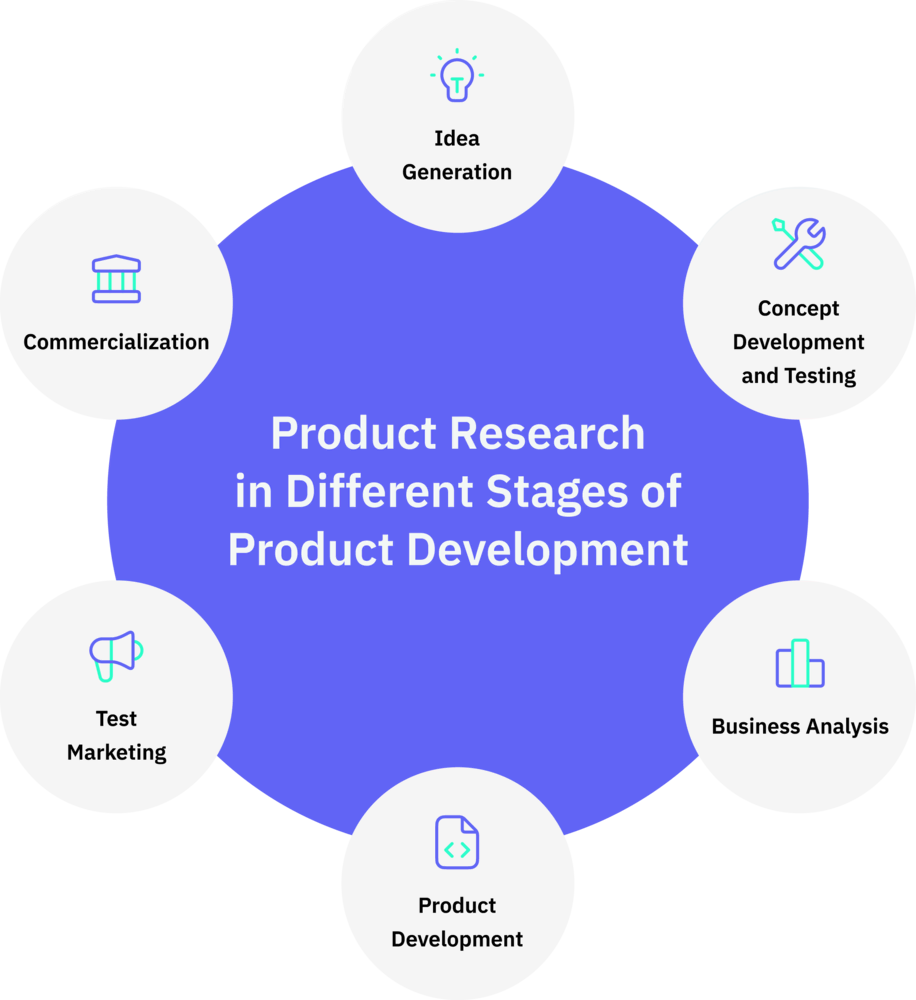
Product research plays a critical role in each stage of product development, from the initial idea generation to the final commercialization. It aids in refining concepts, testing assumptions, and ensuring that the product truly resonates with its target audience.
The very first stage of product development begins with idea generation, and this is where the importance of product research becomes immediately apparent. Market research provides insights into industry trends, emerging markets, and changing consumer behaviors, helping businesses identify promising opportunities and inspiring innovative product ideas. User research further assists in understanding the unmet needs or problems of potential customers, often serving as a springboard for ideation. Competitor research aids in assessing what is already available in the market, thereby guiding businesses towards product ideas that offer unique value or differentiate them from competitors.
Once a product idea is conceived, the next step is to refine and test this concept. Here, product research is employed to validate the product idea and shape its development. User research can help ascertain whether the concept is appealing to potential customers and meets their needs. Feedback gathered from focus groups, various types of surveys, or interviews can be instrumental in refining the product concept, guiding feature selection, and even influencing the product’s design. At the same time, competitor research provides insights into how similar products are performing in the market, which can inform the unique selling proposition (USP) of the new product.
In the business analysis stage, product research assists in evaluating the potential profitability and feasibility of the product. Market research offers data on the size of the potential market, growth prospects, and segmentation, which can inform revenue projections. Similarly, insights from competitor research can provide a sense of the market share that the new product could potentially capture. User research, on the other hand, can help estimate the price potential customers are willing to pay for the product, informing pricing strategy.
As the product begins to take shape during the development phase, user research plays an increasingly important role. User testing allows businesses to gather feedback on the product’s functionality, usability, and overall user experience. This feedback can be used to iteratively improve the product, ensuring it not only functions as intended but also delivers a satisfying user experience. Additionally, competitor research can inform the product’s positioning, helping to differentiate it from similar products on the market.
In the test marketing stage, a prototype or limited launch of the product is tested in a small segment of the market. Product research here can help evaluate the product’s reception, the effectiveness of the marketing strategy, and even the logistics of distribution. Feedback from users can provide valuable insights into any potential issues or improvements, allowing the business to fine-tune the product or strategy before the full-scale launch.
The final stage of product development is commercialization, where the product is launched in the market. Product research continues to play a crucial role even after launch. Post-launch market research can help assess the product’s performance and monitor changing trends. User research, in the form of customer feedback and reviews, offers insights into the product’s strengths and areas for improvement. Furthermore, ongoing competitor research can assist businesses in staying competitive, identifying opportunities for product upgrades, and inspiring new product ideas for the future.
Product research is constantly evolving, driven by technological innovations. Companies now have access to modern tools and methods that make the research process more efficient and accurate. Here are some of the key trends:
A well-conducted product research process can provide a plethora of benefits for businesses. These advantages go beyond merely understanding the product’s potential market, user preferences, or competitive landscape — they directly impact a product’s long-term success.
While the importance of product research is undeniable, it can also present certain challenges that businesses must navigate. Here are the most common hurdles and suggested strategies for overcoming them.
Not all companies, especially startups and small businesses, have abundant resources to dedicate to comprehensive product research. In these cases, focusing on the most essential research types that deliver the biggest impact makes sense. Online surveys, interviews, and competitor analysis are relatively low-cost methods that can still provide valuable insights.
There is always a risk of bias in data collection, which could skew results and lead to inaccurate conclusions. To mitigate this risk, businesses should strive for objectivity in their research methods — using a diverse sample for surveys and interviews, asking neutral questions, and cross-verifying data from multiple sources.
Recommended Reading: Avoiding Bias and Distortion in Questionnaire Design
Sometimes, the data gathered from product research can be complex and challenging to interpret. Businesses may consider using data analysis tools or hiring experts to assist in this step. This ensures that the conclusions drawn from the research are accurate and actionable.
These challenges, while potentially daunting, are surmountable. By recognizing and addressing these issues upfront, businesses can ensure that their product research efforts yield reliable and actionable insights.
An understanding of the value of product research is enhanced by observing its application in real-world situations. The following two case studies illustrate how product research significantly contributed to the success of a product launch.
Imagine a fitness company intending to expand its product line by introducing a new home workout device. Before diving into product development, the company invested in comprehensive market and user research. They discovered a niche of busy professionals who sought effective workout solutions that could be used at home, with minimum space requirements.
Through user interviews, they learned about the pain points these potential customers faced with current products: cumbersome equipment, complex setups, and a lack of personalization. The company used these insights to design a compact, easy-to-set-up device with personalized workout plans. The product became a success, hitting the sweet spot between consumer need and a gap in the market.
Consider a tech startup planning to launch an innovative gardening app using augmented reality to let users visualize different plants in their gardens. Before jumping into the complex development process, they conducted thorough user research. Interviews revealed that the primary user group was not experienced gardeners but beginners who felt overwhelmed by plant care instructions. This finding prompted the team to redesign the app’s onboarding flow and simplify its interface significantly. By addressing the real user need, the app launched to strong reviews and achieved high retention rates in its first three months.
These case studies highlight the importance and efficacy of product research in successfully developing and launching a product. The insights derived from different types of research shape the product’s design, its features, the marketing strategy, and ultimately, its success in the market.
If you want to conduct your own product research, follow these steps to achieve meaningful results:
Ready to start your own product research?
With clickworker, you can reach your exact target audience, create tailored surveys, and receive reliable results — quickly and at scale. No agency needed.
Start your product research survey with clickworker
Product research is essential for understanding markets, customers, and competitors. It provides the insights that help companies develop products that meet real customer needs and succeed in the market. Despite challenges such as limited resources or complex data interpretation, well-planned research remains indispensable. Technological trends and innovative methods are continuously shaping the future of product research, enabling companies to adapt flexibly and strategically to change.
Real-world examples show that investing in product research minimizes the risk of failure, reveals market opportunities, and supports informed decision-making at every stage of development. Companies that actively engage in research gain a clear competitive edge and build products that genuinely delight their customers.
The key insights at a glance:
The importance of product research lies in its ability to help businesses understand their market, customers, and competitors. It provides essential insights that shape the development, marketing, and launch of a product. It minimizes risk, identifies market opportunities, supports decision-making, and enhances the product's overall value proposition.
The three main types of product research are market research, user research, and competitor research. Market research provides a broad understanding of the economic climate, customer base, and demographics. User research focuses on understanding potential users or customers, their needs, and preferences. Competitor research helps businesses understand their competitive landscape.
Common challenges in product research include limited resources, especially for small businesses and startups, bias in data collection that could skew results, and difficulties in interpreting complex data. These challenges can be addressed through cost-effective research methods, objective data collection practices, and the use of data analysis tools or expert support.
Technology is revolutionizing product research in numerous ways. Artificial Intelligence can analyze customer sentiment and large datasets at scale, Virtual Reality enables immersive product testing before market launch, and big data analytics provide deeper insights into customer behavior and market trends. Mobile research tools also allow faster, broader data collection worldwide.
Product research guides each stage of product development, from idea generation to commercialization. It provides insights and data that inform decision-making, help design a product that meets customer needs, support the development of effective marketing strategies, and assess the product's performance after launch.


