


A monadic test is one of the most precise methods in market research. It evaluates a single product or concept in complete isolation: each participant sees only one version, with no competing options presented alongside it. This produces unbiased, undistorted feedback that goes far deeper than simple preference rankings. From concept development to final market launch, monadic tests are used across industries to drive decisions on design, pricing, and marketing strategy. Whether in the food industry, the fashion sector, or in advertising, they deliver a clear picture of how a target audience truly perceives a product.
In this post, we take a detailed look at the design and strategies of monadic tests and show how they can be effectively used for product concept validation.
Table of Contents
- Key Takeaways: Monadic Testing
- What is a Monadic Test?
- The Process of Monadic Testing
- Validating Concepts with Monadic Tests
- Sequential Monadic Tests vs. Rotating Tests
- Applications of Monadic Tests
- Monadic Design – How to Set Up Monadic Tests
- Conducting Monadic Tests via Online Surveys
- Analysis and Interpretation of Results
- Conclusion
- FAQ
The table below summarizes the core aspects of monadic testing at a glance.
| Aspect | Details |
|---|---|
| What is a monadic test? | A monadic test is a market research method where individual products or concepts are evaluated in isolation without comparisons. |
| Areas of Application | Used in product development, price tests, advertising effectiveness, customer satisfaction, and more. |
| Design of Tests | Planning and conducting monadic tests require careful concept development and a representative selection of participants. |
| Online Execution | Online platforms like clickworker offer efficient tools for quick and cost-effective implementation of monadic tests. |
| Data Evaluation | Evaluation of both quantitative and qualitative data to gain deep insights and derive action recommendations. |
| Monadic vs. Rotating | While monadic tests enable an unbiased evaluation, rotating tests provide comparison possibilities between different products. |
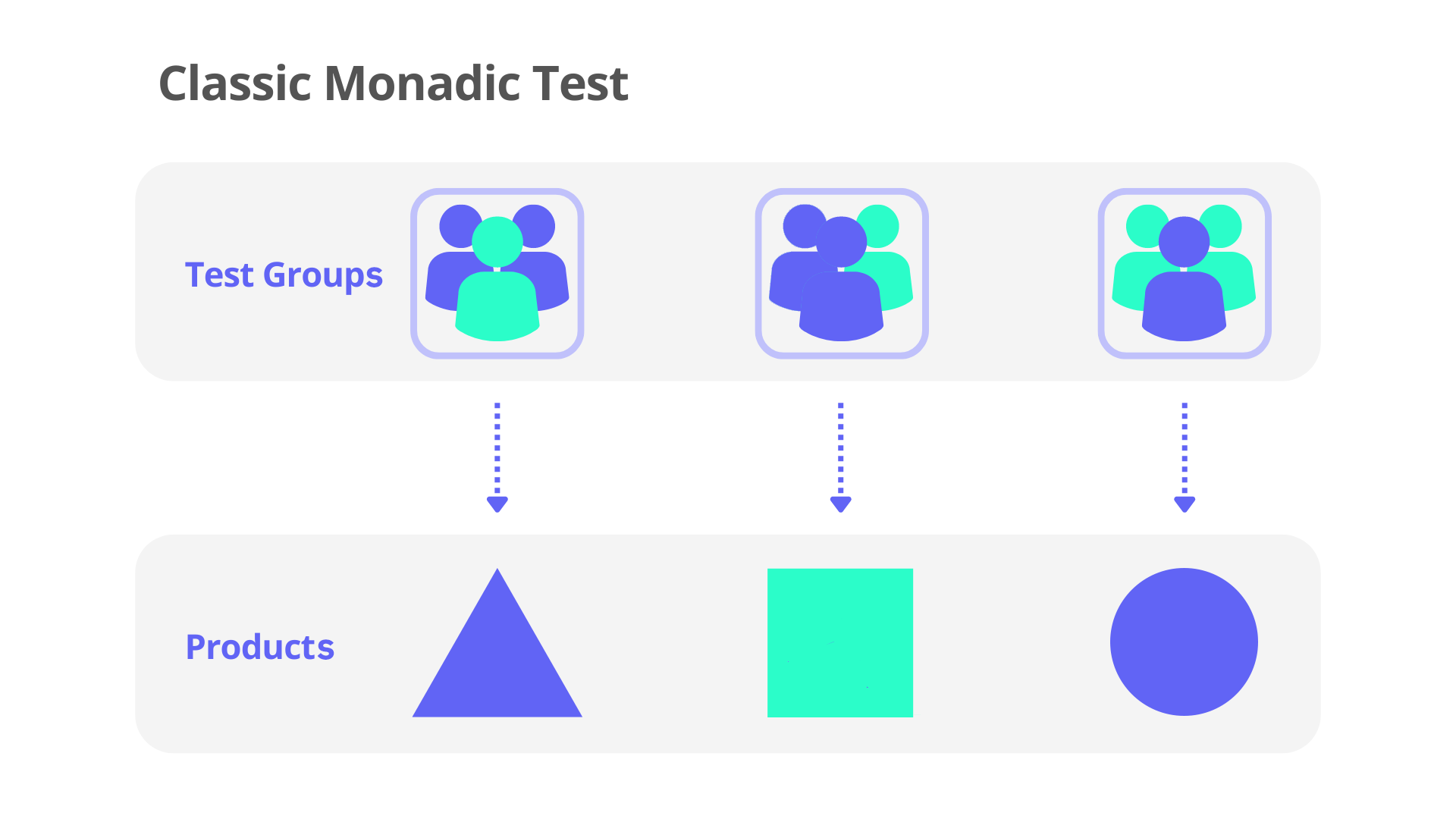
A monadic test is a method in product research where participants evaluate just one single product or concept, without comparing it to other options. This allows for detailed and specific feedback on each individual test object, without judgments being influenced by direct comparisons with other products.
In a monadic test, each participant is presented with only one product or concept. Participants are not aware of other variants being tested in the same study. This isolation ensures that evaluations are based solely on the characteristics of the presented product. Specific strengths and weaknesses can be identified clearly, which is especially important for fine-tuning before a market launch.
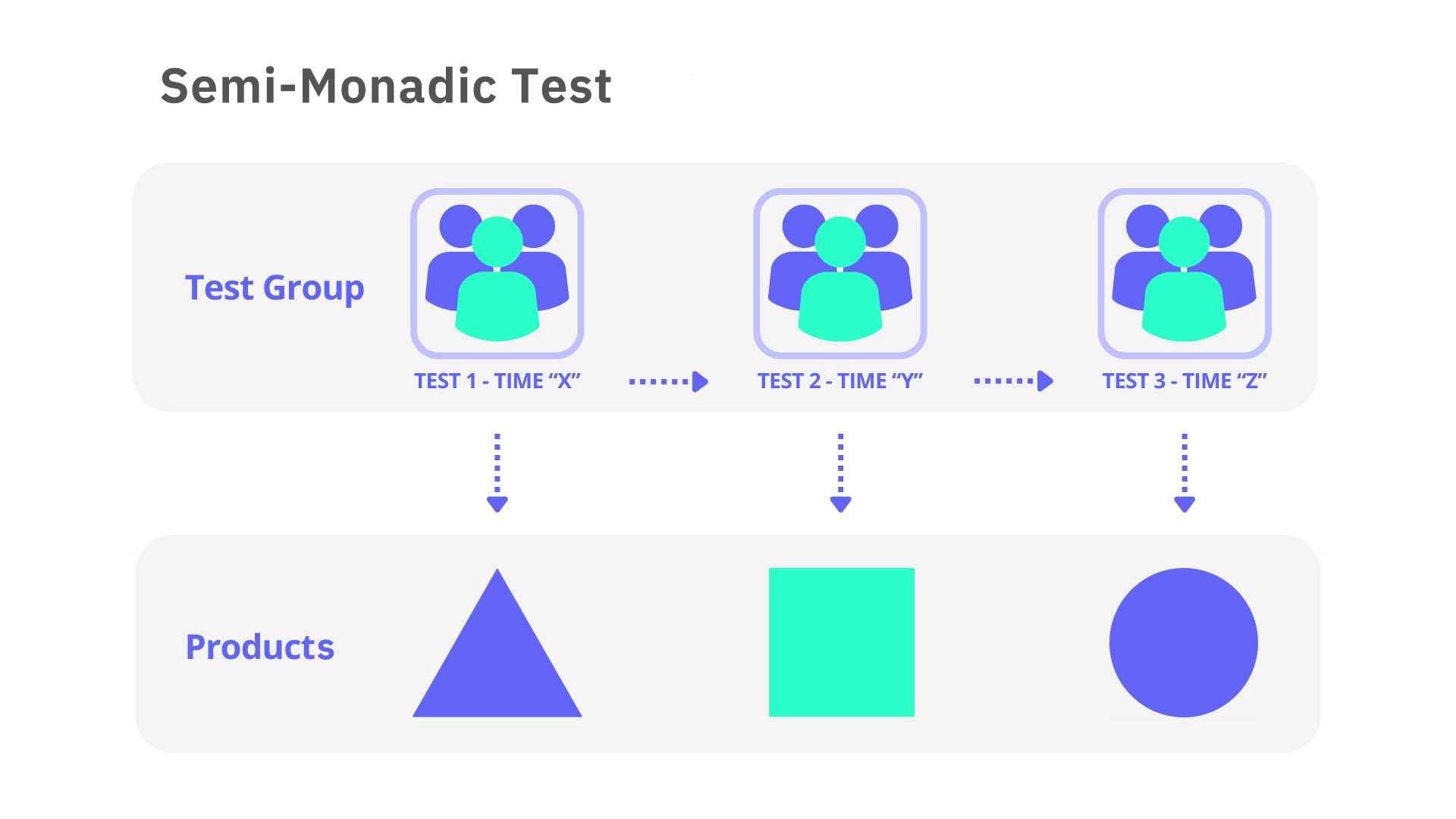
Unlike monadic tests, semi-monadic tests have participants evaluate more than one product or concept, but in separate sessions. This approach allows for a comparison of reactions to different products while still maintaining some of the advantages of the monadic format, such as the isolated evaluation of each product. The key difference lies in the ability to make direct comparisons between products, which is not possible in purely monadic tests.
The process of monadic testing is systematic and requires careful planning and execution to ensure meaningful and reliable data.
Each phase of a monadic test builds on the previous one. Following this sequence helps avoid common design errors and keeps results interpretable.
Concept Development:
First, a clear and detailed concept for the product or service is developed. This can be a physical product, packaging, an advertising concept, or a service.
Participant Selection:
Participants should be representative of the product’s target audience. It is important to ensure they match the demographic and psychographic characteristics of the target customers.
Conducting the Test:
Each participant receives a single product or concept for evaluation. No comparisons to other products are provided, to obtain unbiased results.
Data Collection:
Participants’ reactions and evaluations are collected through direct surveys, online surveys (using survey tools including providing survey participants), observations, or via digital crowdtesting platforms.
Analysis:
The collected data is analyzed to gain insights into the acceptance and evaluation of the product by the target group.
Optimize Your Market Research with Monadic Tests
Explore in-depth consumer preferences through targeted use of monadic tests. clickworker enables you to ask specific questions and design scenarios to get precise feedback on your products or concepts. Utilize our platform to collect clearly defined and unbiased evaluations that are crucial for your product development and marketing strategy.
Learn More About Our Survey Tool
Beyond the step-by-step process, four design principles consistently separate high-quality monadic studies from unreliable ones.
Product concept tests are crucial steps in the product development process. Monadic tests provide an ideal foundation by enabling detailed insights into a target group’s perception and acceptance of a concept.
Three specific use cases make monadic tests particularly valuable during concept validation.
Monadic tests work best when combined with complementary research methods that add qualitative depth.
The choice between sequential monadic tests and rotating tests can significantly impact the quality and reliability of the data collected.
The sequential monadic test, a variant of the classic monadic approach, allows participants to evaluate several products one after another in separate sessions. This increases accuracy, as evaluations are less influenced by immediate side-by-side comparisons.
The rotating test, by contrast, presents participants with different products in varying order for evaluation. This method is particularly useful for minimizing order effects and achieving a more balanced picture of product evaluations across the sample.
Neither method is universally superior; the right choice depends on the research objective and available resources.
Both in sequential monadic and rotating tests, randomization plays a critical role in avoiding biases. An even distribution of products across different test groups is essential for reliable and meaningful results.
Monadic tests are versatile and deliver valuable insights across a wide range of market research contexts.
In monadic price tests, the reaction of the target group to different price points of a product is examined. These tests are crucial for determining price elasticity and the optimal pricing for a new product or service. Because each participant evaluates only one price, responses are not distorted by anchoring effects.
A new product or product variation is tested in isolation to get direct feedback on acceptance, preferences, and overall satisfaction from consumers. Such tests are especially valuable for decisions about product features and functions before committing to a final design.
Beyond pricing and product features, monadic tests are regularly used in several adjacent research areas.
In practice, monadic tests enable a more accurate evaluation of individual concepts compared to rotating tests, by eliminating influences from the simultaneous evaluation of competing products.
A well-structured monadic design is the foundation for results that are both meaningful and actionable. Rushing the setup phase is the most common source of unreliable data.
Three elements consistently determine whether a monadic test delivers usable insights.
Even well-planned studies can fail at the execution stage. These three practices significantly reduce the most frequent errors.
Randomization of test participants and an even distribution of test objects across cells are essential to avoid systematic biases and ensure the validity of results.
Online surveys have become the standard format for monadic testing, offering both scale and speed that traditional in-person methods cannot match.
Three advantages in particular make online surveys the preferred channel for monadic test execution.
Successful implementation relies on three operational capabilities that dedicated survey platforms provide.
Two challenges require particular attention when moving monadic tests into online environments.
The analysis and interpretation of data collected through monadic tests are central steps for drawing well-founded conclusions and gaining actionable insights.
Robust analysis combines both statistical rigor and qualitative understanding.
Three interpretive steps convert raw data into strategic decisions.
Two recurring challenges deserve particular attention during the analysis phase.
Monadic tests are an indispensable tool in market research. By evaluating products and concepts in complete isolation, they deliver feedback that is free from the distortions of direct comparison, giving researchers a true picture of how consumers respond to a single offering. The method scales from early-stage concept validation to pre-launch price testing, and its flexibility makes it applicable across virtually every industry.
Conducting monadic tests via online platforms such as clickworker combines this methodological rigor with practical efficiency: large, targeted samples can be reached quickly and cost-effectively, and real-time data collection shortens the path from fieldwork to decision. With careful design, representative participant recruitment, and thorough analysis, monadic tests provide the kind of clear, actionable data that product teams and marketers need to move forward with confidence.
The key insights at a glance:
Run Monadic Tests with clickworker
Access over 10 million verified survey participants worldwide. Define your target group, launch your monadic test, and receive results fast — without an agency.
Find Survey Participants Now
A monadic test is a research methodology where each participant evaluates only one product or concept without comparing it to others. This isolation helps obtain unbiased feedback on specific features or overall acceptance, providing clear insights into individual product strengths and weaknesses.
Designing a monadic test involves defining clear objectives, selecting the right product or concept to test, and determining the target audience. Careful planning ensures that each element of the test — from the survey design to participant instructions — is tailored to isolate the product's impact and accurately gauge consumer reactions.
Unlike comparative tests, where participants evaluate multiple products simultaneously or sequentially in the same session, monadic tests focus on a single product per participant. This avoids the influence of direct comparison, allowing researchers to gather more precise data on how a product stands alone in the market.
The main advantages of monadic tests include the ability to identify specific product attributes that resonate with consumers, reduced bias from not comparing products directly, and the provision of clear, actionable data that can directly influence product development and marketing strategies.
Monadic tests are widely used in product development, pricing strategies, and marketing campaign assessments. They are particularly valuable for detailed evaluations in the initial stages of product design and for final adjustments before launching a product to the market.
Online monadic tests are implemented using digital platforms that facilitate the presentation of surveys or test scenarios to participants. Platforms like clickworker allow researchers to target specific demographic groups, ensuring the data collected is relevant and representative. clickworker's tools support rapid data collection and include multimedia elements for a more comprehensive assessment, as well as real-time data analysis capabilities that allow researchers to adapt tests based on initial feedback.


