

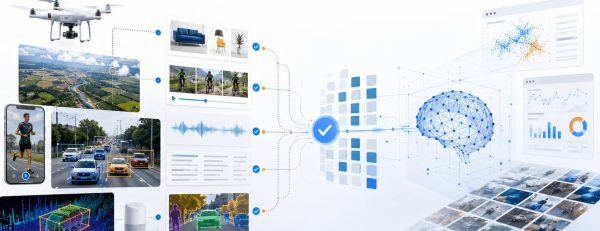
When a machine learning model fails in production, the root cause is rarely the algorithm. In most cases, the training data is to blame. A computer vision system that performs flawlessly on benchmark images but misidentifies real-world objects has not learned to see — it has learned to recognize patterns in a specific, often unrealistic dataset. The result: expensive retraining cycles, delayed product launches, and in safety-critical applications like autonomous driving or medical imaging, real-world consequences.
Training data for machine learning is the single most important input in the entire ML pipeline. No amount of model fine-tuning compensates for data that does not reflect the conditions under which a system will actually operate. This guide explains what makes training data realistic and reliable, how to evaluate data quality, where bias enters the pipeline, and how organizations can source machine learning training data that holds up in production.
Table of Contents
- What Is Training Data for Machine Learning?
- Why Realism in Training Data Matters
- How to Evaluate the Quality of Your Training Data
- Types of Machine Learning Training Data and Their Realism Requirements
- Common Sources of Bias in Training Data
- Synthetic Data vs. Human-Generated Training Data
- Human-in-the-Loop: When Human Judgment Is Non-Negotiable
- How Crowdsourcing Solves the Training Data Problem
- Conclusion
- FAQ
Training data is the labeled dataset an ML model learns from during the supervised learning process. Every input-output pair in that dataset teaches the model a pattern: this image shows a cat, this sentence expresses a negative sentiment, this audio clip contains the word “cancel.” The model adjusts its internal parameters across thousands or millions of such examples until it can generalize to new, unseen inputs.
The quality and composition of training data directly determine what a model learns and how well it performs outside the training environment. A model trained on skewed, incomplete, or context-inappropriate data will learn skewed, incomplete, or context-inappropriate patterns. This relationship is often described with the phrase “garbage in, garbage out” — but the more precise framing is “distribution mismatch.” If the statistical properties of the training data do not match the distribution of real-world inputs, model performance will degrade exactly where it matters most: in production.
The term “ground truth” refers to the correct labels assigned to training examples. Ground truth quality is foundational: a model cannot learn to classify correctly if its training labels are inconsistent or wrong. Inter-annotator agreement — the degree to which independent human annotators assign the same label to the same input — is one of the most reliable indicators of label quality. Industry benchmarks typically require agreement rates above 85% for text classification tasks and above 90% for critical image annotation tasks such as medical imaging.
Realistic training data reflects the conditions, distributions, and edge cases a deployed model will actually encounter. When training data is sourced from convenient but unrepresentative pools — stock photo libraries, publicly available web data, or artificially constructed examples — the gap between training performance and production performance tends to be significant.
A concrete example illustrates the issue clearly. A development team building software for drone cameras sources its training images from Facebook and Instagram. These images are plentiful and easily accessible — but they share two structural features: they are taken at roughly head height, and the main subject is almost always centered in the frame. A model trained on this data will learn these compositional patterns as general rules. When deployed on an actual drone, it encounters images taken from above, with subjects off-center, at unusual angles and distances. The model’s learned heuristics fail immediately, and the team must restart data collection from scratch.
A similar problem arises in autonomous vehicle development. Training a car’s perception system on traffic imagery from multiple countries introduces a specific risk: the model may encounter foreign road signs, lane markings, or traffic conventions it was not trained to distinguish from local ones. In Germany, a model trained on globally sourced data might misclassify an advertising billboard that resembles a road sign from another jurisdiction. In safety-critical systems, such misclassifications are not acceptable edge cases — they are fundamental failures.
The financial consequences of training with unrealistic data are substantial. Retraining a large model from scratch typically costs tens of thousands of euros in compute resources alone, not counting the time required for data collection, annotation, and quality review. More importantly, every iteration that relies on the wrong data is a wasted iteration. Organizations that invest in representative, realistic training datasets from the beginning reduce retraining cycles, shorten time-to-production, and build more robust systems.
Not all datasets marketed as “training data for machine learning” are fit for use in a specific system. Evaluating a dataset requires looking at several dimensions simultaneously: accuracy, representativeness, freshness, labeling consistency, and coverage of edge cases.
Each of the following dimensions can independently compromise model performance if it falls short of requirements.
Before integrating an existing dataset into a training pipeline, the following questions provide a structured evaluation framework.
Several warning signs indicate that a dataset is unlikely to produce a reliable model. Datasets with high rates of incorrect labels, significant redundancy, large numbers of outliers without a clear distribution rationale, or a narrow demographic or geographic scope all warrant scrutiny. A dataset that does not come with documentation of its collection methodology and annotation process should be treated with caution.
Need Training Data That Meets Your Quality Standards?
clickworker provides human-generated and human-verified training data for text, image, audio, and video — annotated by a global crowd of over 10 million workers, with multi-layer quality assurance built in.
Get AI Training Data from clickworker
Different ML applications require fundamentally different types of training data. Each data type comes with its own realism requirements — the specific properties that determine whether the data accurately represents the conditions the model will face in production.
Natural language processing models require text data that reflects how language is actually used in the target domain and demographic. For a sentiment analysis model deployed on customer service tickets, training on movie reviews introduces a distribution mismatch: the vocabulary, sentence structure, topic distribution, and emotional register of customer service language differ substantially from film criticism. Realistic NLP training data for machine learning tasks needs to match the domain, register, and linguistic characteristics of the intended use case. This extends to multilingual models, where each language variant must be represented by speakers or writers native to that language, not by machine-translated text.
Computer vision models are particularly sensitive to photographic conditions. Training images must reflect the camera type, resolution, lighting conditions, angles, distances, and environmental contexts the system will encounter in operation. A precise image annotation process — including bounding boxes, polygons, semantic segmentation, and keypoint annotation — ensures that labeled objects in training images correspond exactly to what the model needs to learn. For video data, temporal consistency across frames is an additional requirement: objects must be tracked and labeled consistently as they move through a scene.
Automatic speech recognition (ASR) systems trained on read-aloud speech from a narrow demographic perform poorly on spontaneous speech, regional accents, background noise, or overlapping voices. Realistic audio training data for machine learning reflects the actual acoustic environments and speaker profiles of the deployment context. A voice assistant intended for elderly users, for example, requires training data from speakers in that age group — not from a convenience sample of younger, university-educated speakers. Multilingual and multi-accent coverage is equally critical for global deployments.
Tabular datasets used in fraud detection, credit scoring, or predictive maintenance carry their own realism requirements. Class imbalance is a common problem: fraud events or equipment failures are rare in real-world data, and a model trained on an artificially balanced dataset will behave differently when it encounters the actual distribution. Data augmentation strategies for structured data must be applied with care to avoid introducing statistical artifacts that do not exist in the real data pipeline.
| Data Type | Key Realism Requirement | Common Pitfall |
|---|---|---|
| Text / NLP | Domain and register match | Cross-domain transfer without adaptation |
| Image / Video | Camera conditions, angle, lighting match | Studio images for outdoor deployment |
| Audio / Speech | Acoustic environment and speaker diversity | Narrow demographic, read speech only |
| Tabular / Structured | Real-world class distribution | Artificial balancing of rare events |
Bias in training data produces biased models. This is not a theoretical concern: documented cases of biased ML systems in hiring, lending, facial recognition, and healthcare have demonstrated concrete harm. Understanding where bias originates in the training data pipeline is a prerequisite for controlling it.
Sampling bias occurs when the data collection process systematically over- or underrepresents certain groups or conditions. A facial recognition system trained primarily on images of people with lighter skin tones will show significantly higher error rates for people with darker skin tones. This is not a model architecture problem; it is a data problem. The training distribution does not match the deployment distribution. Correcting it requires intentional sampling strategies that ensure demographic, geographic, and contextual diversity in the training dataset.
Label bias enters the dataset when human annotators apply different standards to different groups, either consciously or unconsciously. In sentiment analysis, the same sentence may receive different labels depending on whether the annotator interprets it in a cultural context they are familiar with. In content moderation, annotators with different cultural backgrounds may apply different standards to ambiguous content. Multi-annotator workflows with explicit adjudication rules and calibration on gold sets reduce but do not eliminate label bias. Monitoring inter-annotator agreement across annotator subgroups provides an early signal when systematic labeling differences are present.
Temporal bias arises when training data captures a distribution that has since shifted. Language models trained on text from five years ago may not reflect current terminology, sentiment associations, or cultural references. Fraud detection models trained before a new fraud vector became widespread will not recognize it. Machine learning training data must be refreshed at intervals appropriate to the rate of change in the deployment domain. For rapidly evolving domains, continuous data collection and incremental training are standard practice.
When annotators are aware of expected outcomes or have been briefed on what a model “should” learn, their labels tend to confirm those expectations. Blind annotation — where annotators do not know how their labels will be used — reduces this effect. Quality-conscious data providers use annotation workflows designed to minimize annotator awareness of the training objective.
As the demand for large, diverse, and well-labeled training datasets has grown, synthetic data generation has emerged as a widely used strategy. Understanding where synthetic data works and where it falls short is essential for making informed sourcing decisions.
Synthetic data can be generated at scale without the cost and time requirements of manual data collection. It allows precise control over label accuracy — labels are assigned programmatically, eliminating the inter-annotator agreement problem. For rare events and edge cases that are difficult to capture in real-world data (equipment failures, accidents, unusual weather conditions), synthetic generation can create the training examples a model needs. In computer vision, rendering engines can produce labeled images of objects from any angle, distance, and lighting condition.
The fundamental limitation of synthetic data is the domain gap: the statistical difference between synthetically generated data and real-world data. A model trained entirely on synthetic images will typically underperform when deployed on real images, because rendering engines do not capture the full complexity of real-world visual scenes — lens distortion, sensor noise, motion blur, reflections, and occlusion patterns differ from their synthetic counterparts. Similarly, synthetically generated text tends to have different statistical properties from authentic human-written text, particularly in informal registers. Large language models used to generate synthetic training data can introduce the biases and failure modes of the generator model into the new dataset.
Most production ML pipelines combine synthetic and human-generated data. Synthetic data handles scale and coverage of rare events; human-generated data provides the authentic distribution properties that close the domain gap. The balance between the two depends on the task, the available budget, and the performance requirements of the deployed system. Human review of synthetic data — verifying that programmatically generated labels are correct and that examples are realistic enough to be useful — adds a quality layer that is often necessary when synthetic data is used at significant scale.
Human-in-the-Loop (HITL) refers to workflows where human judgment is integrated into the machine learning pipeline — not just during initial data annotation, but as an ongoing component of model development, evaluation, and quality assurance. Certain tasks and certain quality levels cannot be achieved without it.
Several annotation tasks resist full automation because they require contextual understanding, cultural knowledge, or nuanced interpretation that current models cannot reliably provide. Sentiment analysis on ambiguous or ironic text, content moderation for culturally specific material, intent classification in conversational AI, and relevance judgment in information retrieval all fall into this category. For these tasks, human annotators are not a stopgap solution — they are the appropriate tool.
Reinforcement Learning from Human Feedback (RLHF) has become a standard technique for aligning large language models with human preferences. In RLHF pipelines, human raters evaluate model outputs, rank competing responses, and provide preference signals that guide the model’s fine-tuning. The quality of the human feedback data determines the quality of alignment: raters with domain expertise, clear evaluation guidelines, and calibrated judgment produce more useful preference signals than untrained raters working from vague criteria. Data annotation providers with experience in RLHF workflows understand the specific quality requirements that make human feedback data effective.
Active learning is a strategy where the model identifies the training examples it is most uncertain about and routes them to human annotators for labeling. This approach concentrates annotation effort on the examples that provide the most information, rather than distributing it uniformly across a large dataset. The result is more efficient use of annotation resources and faster model improvement. HITL workflows that incorporate active learning are particularly valuable in domains where high-quality labeled data is expensive to produce.
Human-in-the-Loop Annotation at Scale
clickworker’s crowdsourcing platform supports the full HITL data pipeline — from initial data collection and annotation to RLHF preference ranking and ongoing quality review — with over 10 million workers worldwide available for multilingual tasks.
Explore AI Training Data Services
Crowdsourcing connects organizations that need large volumes of labeled training data with distributed networks of qualified workers. For machine learning training data at scale, crowdsourcing offers a combination of speed, linguistic and demographic diversity, and cost efficiency that in-house annotation teams cannot easily replicate.
In a well-structured crowdsourcing workflow, crowd workers contribute to training data in three distinct ways, each addressing a different part of the data pipeline.
The quality of crowdsourced training data depends heavily on the quality control layer applied to the annotation workflow. Peer review, dual control (having two independent annotators label the same item), majority decision for ambiguous cases, and gold set calibration (testing annotators on items with known correct labels) are standard mechanisms. Data annotation providers that operate at professional scale apply multiple QA layers rather than relying on any single method. The result is training data that consistently meets the accuracy and consistency requirements of production ML systems.
One of the most significant advantages of large crowdsourcing platforms over in-house annotation teams is the ability to scale rapidly and to cover a wide range of languages. Machine learning training data for multilingual models requires native speakers of each target language — not translators, and not speakers with only passive fluency. A platform with workers in more than 130 countries can source authentic training data in dozens of languages simultaneously, with the geographic and demographic diversity that realistic datasets require.
Existing datasets that fall short of current quality requirements do not necessarily need to be discarded. Within short turnaround times, crowd workers can enrich raw data by adding keywords and tags, applying precise image annotations using bounding boxes, polygons, and keypoints, carrying out semantic segmentations, or correcting incorrect labels from previous annotation rounds. This rehabilitation process is often faster and less expensive than starting a new data collection from scratch.
The performance ceiling of any machine learning model is set by the quality of its training data. Unrealistic, biased, or inconsistently labeled data produces models that perform well on benchmarks but fail in production. Identifying and addressing data quality issues before training begins — rather than after deployment — is consistently the more cost-effective path.
Organizations that treat training data for machine learning as a strategic asset rather than a procurement commodity make better-informed decisions about data collection methodology, annotation workflow design, and quality assurance. They build models that generalize reliably, require fewer retraining cycles, and perform predictably in the conditions they were designed for.
The key insights at a glance:
Training data for machine learning is a labeled dataset used to teach an ML model to recognize patterns and make predictions. Each example in the training set consists of an input (such as an image, text, or audio clip) and a corresponding label (the correct output the model should learn to produce). The model adjusts its parameters during training to minimize the difference between its predictions and the correct labels.
The required volume of training data depends on the complexity of the task, the number of classes or output categories, and the model architecture. Simple binary classification tasks may perform well with a few thousand labeled examples. Deep learning models for computer vision or NLP typically require hundreds of thousands to millions of labeled examples to achieve production-quality performance. Data quality has a greater impact than data volume beyond a certain threshold: 10,000 accurately labeled and representative examples consistently outperform 100,000 noisy or unrepresentative ones.
Training data is used to fit the model's parameters. Validation data is used during training to tune hyperparameters and monitor for overfitting — it provides feedback on model performance without being used to update weights. Test data is held out entirely until after training and validation are complete; it provides an unbiased estimate of how the model will perform on new, unseen data. The standard split for many tasks is 70–80% training, 10–15% validation, and 10–15% test data, though this varies significantly by task and dataset size.
Bias in training data can originate from three main sources. Sampling bias occurs when the data collection process systematically over- or underrepresents certain groups, geographies, or conditions. Label bias arises when human annotators apply inconsistent or culturally influenced standards to ambiguous inputs. Temporal bias enters when the data reflects a past distribution that no longer matches the current deployment environment. Mitigating bias requires intentional sampling strategies, annotator calibration, and regular dataset refreshes.
Human-in-the-Loop (HITL) refers to workflows where human judgment is integrated into the ML pipeline — for initial annotation, for reviewing model outputs, for identifying errors, and for providing preference signals used in RLHF. HITL is particularly valuable for tasks that require contextual understanding, cultural knowledge, or subjective evaluation that current automated methods cannot reliably handle. It is also a standard component of active learning pipelines, where the model routes its most uncertain examples to human annotators.
Reinforcement Learning from Human Feedback (RLHF) is a technique for aligning language models with human preferences. Human raters evaluate pairs of model outputs and indicate which response is better according to specified criteria. The model is then fine-tuned to produce outputs that match the preferred responses. The quality of the alignment depends directly on the quality of the human feedback data: raters with relevant domain knowledge, consistent evaluation guidelines, and adequate calibration produce preference signals that result in better-aligned models.
Synthetic data can supplement human-generated training data effectively — particularly for rare events, edge cases, and conditions that are difficult or expensive to capture in the real world. However, synthetic data introduces a domain gap: statistical differences between generated and real data that cause models trained only on synthetic examples to underperform on real inputs. Most production pipelines use a hybrid approach, combining synthetic data for scale and edge case coverage with human-generated data to close the domain gap and achieve production-quality performance.
clickworker sources and labels training data through a global crowd of over 10 million workers covering more than 130 countries. Services include text annotation, image labeling with bounding boxes, polygons, semantic segmentation, and keypoint annotation; audio recording and transcription; RLHF preference ranking; and human review of AI-generated outputs. Quality assurance is multi-layered, using peer review, dual control, gold set calibration, and inter-annotator agreement monitoring. The platform supports managed service and self-service workflows, with API access for integration into existing data pipelines.

Leave a Reply


